
Pregnant, exhausted, and running low on iron for two.
Tablets take weeks you don't have. An NHS infusion would take even longer.
Doctor-led IV iron from your second trimester, with an NMC-registered midwife in the room and CTG monitoring on your baby throughout.
No card, no obligation — you only pay if you go ahead.
- The UK's only independent iron infusion hospital
- HIW-registered, in Cardiff
- Emergency-medicine doctor on site
- Report to your GP and maternity team in 24 hours
Everyone says it's just pregnancy. Sometimes it isn't.
Up to 1 in 4 pregnant women in the UK are iron deficient, and the symptoms overlap almost exactly with normal pregnancy — which is precisely why it gets missed for months. Exhaustion, breathlessness, brain fog and palpitations all get put down to the bump. Sometimes that's all it is. If it's your iron, that shows up on a blood test — and it's treatable.
Learn more about iron deficiencySymptoms in pregnancy
- Exhaustion that rest doesn't fix
- Breathlessness climbing stairs or walking
- Heart palpitations or racing pulse
- Dizziness or feeling faint
- Difficulty concentrating or brain fog
- Restless legs, especially at night
- Pale skin, lips, or inner eyelids
- Headaches that won't shift
- Feeling cold when others are warm
- Anxiety or low mood without clear cause
Your baby builds their blood out of your iron.
From the second trimester your baby draws iron across the placenta to build their own blood supply, brain and muscle — and to lay down the stores they'll live on for the first months after birth. Your own blood volume rises by up to 50% at the same time. Total demand across a pregnancy is around 1000mg, most of it after 20 weeks. If your stores were low to begin with, supply runs out before demand does.
Iron deficiency that progresses to anaemia in pregnancy is associated with lower birth weight and preterm birth, and with a higher chance of needing a blood transfusion around delivery. Babies born to mothers who were deficient tend to start life with lower iron stores of their own. These are associations across populations, not predictions about your pregnancy — what matters is your numbers, and a blood test settles those.
NICE recommends every pregnant woman is screened for anaemia at booking and again at 28 weeks. A ferritin and haemoglobin test settles it either way.
~1000mg
of iron needed across pregnancy
Most of it after 20 weeks — when your baby is drawing hardest and you have least time left.
Up to 1 in 4 pregnant women in the UK have iron deficiency. Many don't know.
Up to 40%
get gut side effects from oral iron
Nausea, constipation, stomach cramps — on top of everything pregnancy is already doing.
Oral iron typically needs 6–8 weeks to shift your levels. An infusion delivers its dose in one session.
Months on tablets. Ferritin hasn't moved.
Oral iron is the right first-line treatment and it works well for a lot of women. When it doesn't, there's usually a reason: tablets have to survive your gut and be absorbed there, and up to 40% of people get gastrointestinal side effects that make them impossible to keep taking. If you stopped because of the constipation, that's a clinical reason to change treatment — more so if you're managing piles or a prolapse alongside it.
IV iron skips that problem entirely. It goes directly into your bloodstream, bypassing the gut, delivering a therapeutic dose in a single session. NICE guidance supports IV iron in pregnancy when oral iron has failed, isn't tolerated, or when there isn't enough time before delivery for tablets to work.
Your three options, compared honestly
Dietary iron
Red meat, dark leafy greens, and fortified cereals contribute to iron intake. However, dietary sources alone are rarely sufficient to correct established deficiency during pregnancy, particularly in the later trimesters when demand is highest.
Helpful for maintenance — unlikely to correct deficiency alone.
Oral iron supplements
First-line treatment recommended by NICE, and effective for many women. Gastrointestinal side effects — nausea, constipation, stomach cramps — are common, and difficult alongside pregnancy symptoms. Oral iron typically takes 6–8 weeks to improve levels.
First-line treatment — but not tolerated by everyone.
IV iron infusion
When oral iron has failed or isn't tolerated, IV iron delivers a therapeutic dose directly into the bloodstream in a single session. NICE-recommended from the second trimester. Bypasses the gut entirely — no nausea, no constipation.
NICE-recommended when oral iron fails or time is limited.
Who's in the room when your infusion runs
This is who is with you, and what is monitored, for every antenatal infusion at IronOx.
An emergency-medicine doctor
Dr Ros (GMC 7265326) is a doctor with acute and emergency medicine expertise — the kind whose day job is the first ten minutes of something going wrong. She assesses you and sets your dose, and a doctor is on site for the whole session.
An NMC-registered midwife — every time
Every antenatal infusion here is run with a registered midwife present. Not on call, not down the corridor. In the room, for the whole session.
CTG on your baby, throughout
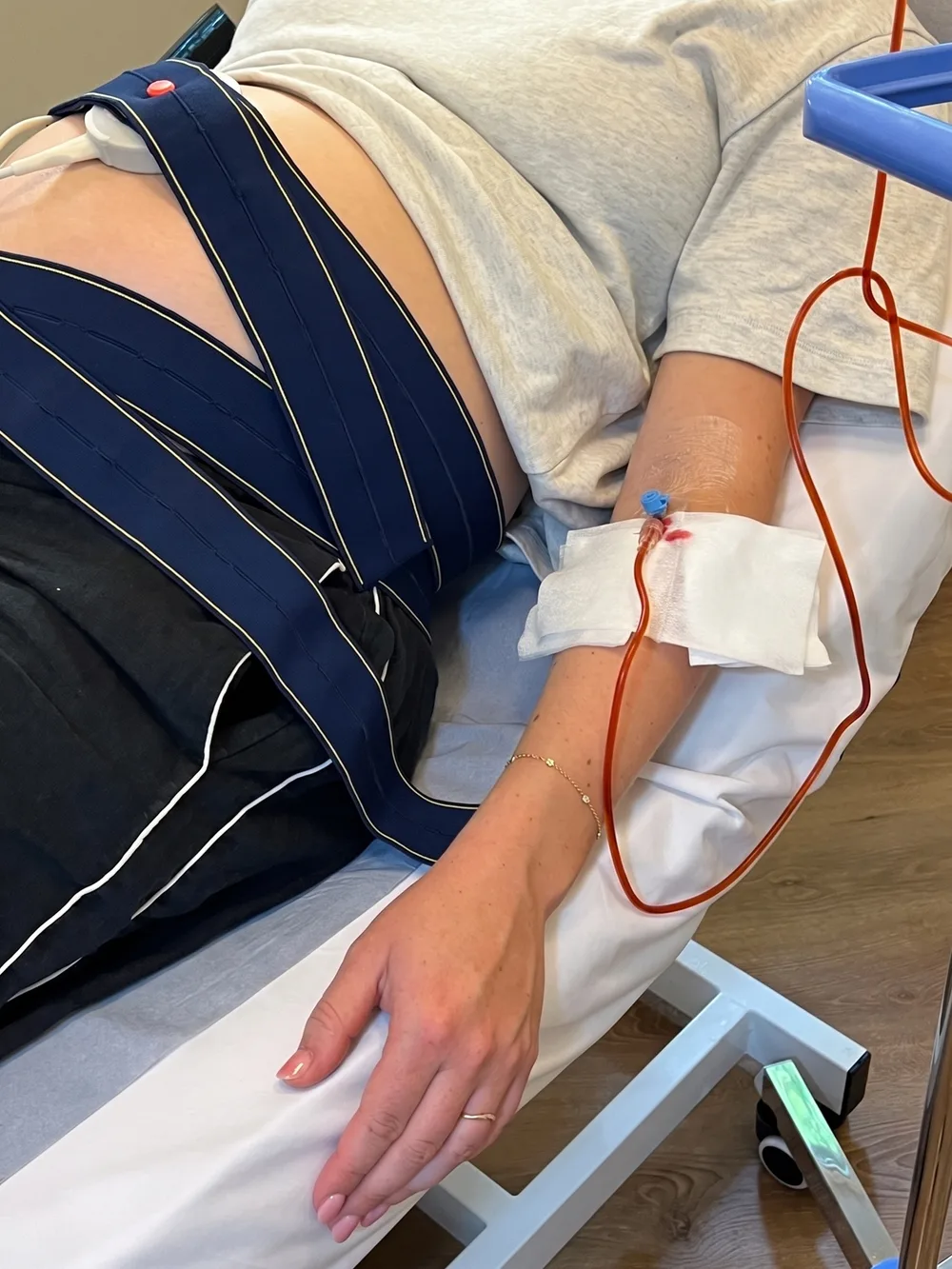
Your baby's heart rate is traced continuously, from before the iron starts running until after it finishes. Standard for every pregnant patient — not something you have to ask for or qualify for. The photographs further down this page are that monitoring, on a real patient.
A registered independent hospital
IronOx is registered with Healthcare Inspectorate Wales as an independent hospital (HIW/02039RM) — the same regulator that inspects hospitals in Wales. Verifiable on the public register.
The iron itself is ferric carboxymaltose, the same IV iron used across NHS hospitals. It's given slowly rather than as a rapid injection, with maternal observations throughout and thirty minutes of monitoring afterwards. Serious reactions are rare — around 1 in 10,000 infusions — and everything above is here in case you're the one.
One session. Not another trimester of tablets.
Two appointments, about an hour of treatment, and your maternity team kept in the loop throughout.
Free telephone consultation
No referral needed. Dr Ros reviews your bloods, your symptoms, your gestation and your maternity plan, and tells you whether IV iron is right for you. Completely free — no deposit, no card, and we will say so if the answer is no.
Your infusion
A 30-minute infusion in a calm clinical room, then 30 minutes of monitoring. A registered midwife is with you throughout, CTG traces your baby's heart rate from start to finish, and you have maternal observations alongside it.
Your midwife gets the report
Within 24 hours your GP and maternity team receive your pre-treatment bloods, the dose given, how the session went, and any follow-up we recommend. Most patients notice a difference within 1–2 weeks.
Your maternity team stays in charge. We fill in the iron.
Specialist clinical assessment
Every pregnant patient is assessed individually by Dr Ros before treatment. We review your bloods, your symptoms, your gestation and your maternity history to decide whether IV iron is clinically appropriate for you — and we will say so if it isn't.
NICE-aligned treatment
We follow NICE guidance for IV iron in pregnancy. Treatment is only recommended when clinically indicated: when oral iron has failed, isn't tolerated, or when there isn't enough time before delivery for supplementation to work.
Maternity team coordination
Within 24 hours of your infusion we send a full clinical report to your GP and maternity team. Your midwife and obstetrician will know exactly what was given, when, and why — so your pregnancy care stays joined up.
Antenatal monitoring, including CTG
Your infusion takes place in a calm clinical setting with a registered midwife present and maternal observations throughout. CTG fetal monitoring runs on every antenatal infusion as standard, from before the iron starts until after it finishes.
Inside the room
What an antenatal iron infusion actually looks like
These are photographs from a real antenatal iron infusion at our Cardiff clinic — not stock images, and not another clinic's room. The CTG belts you can see are the monitoring described above.
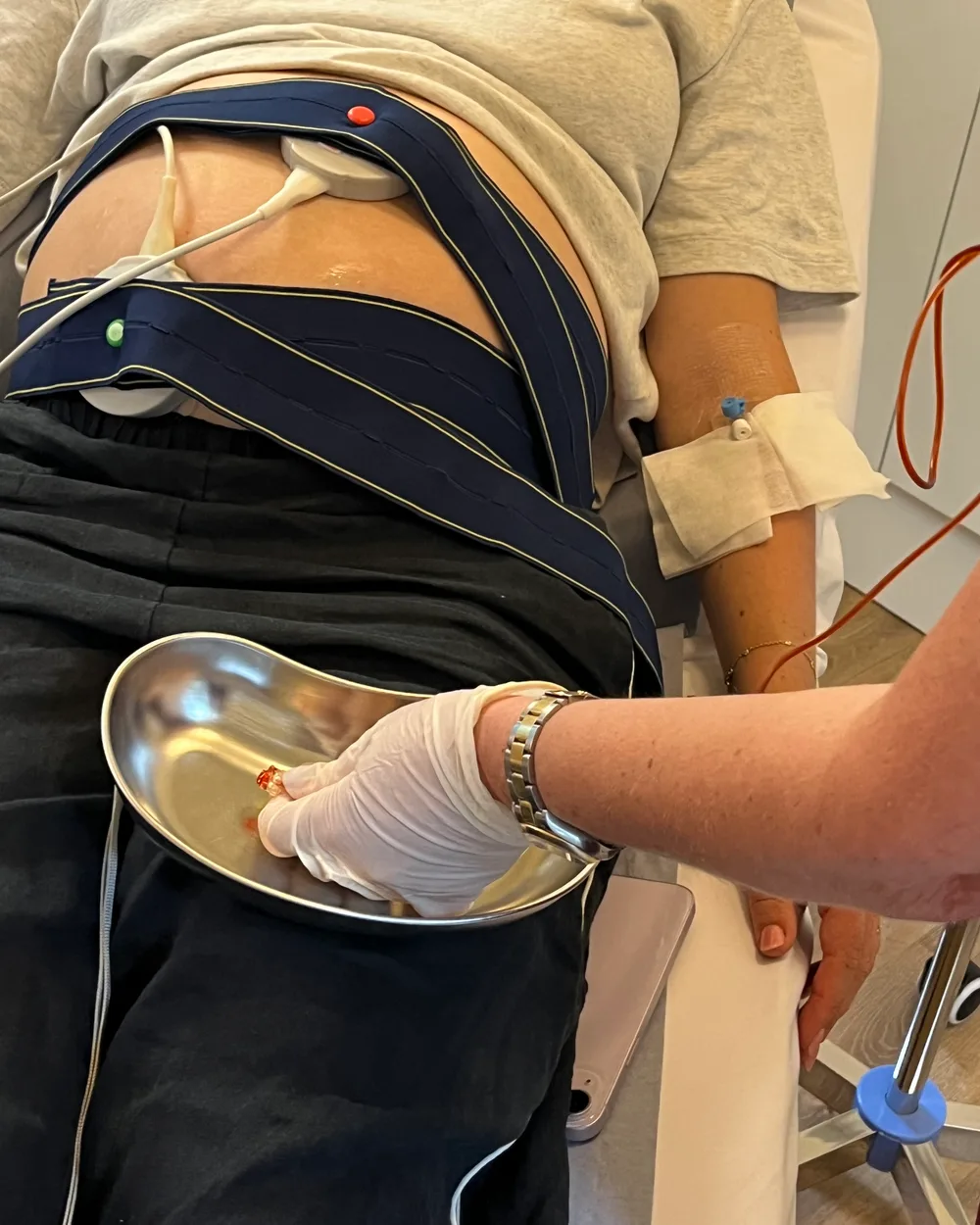
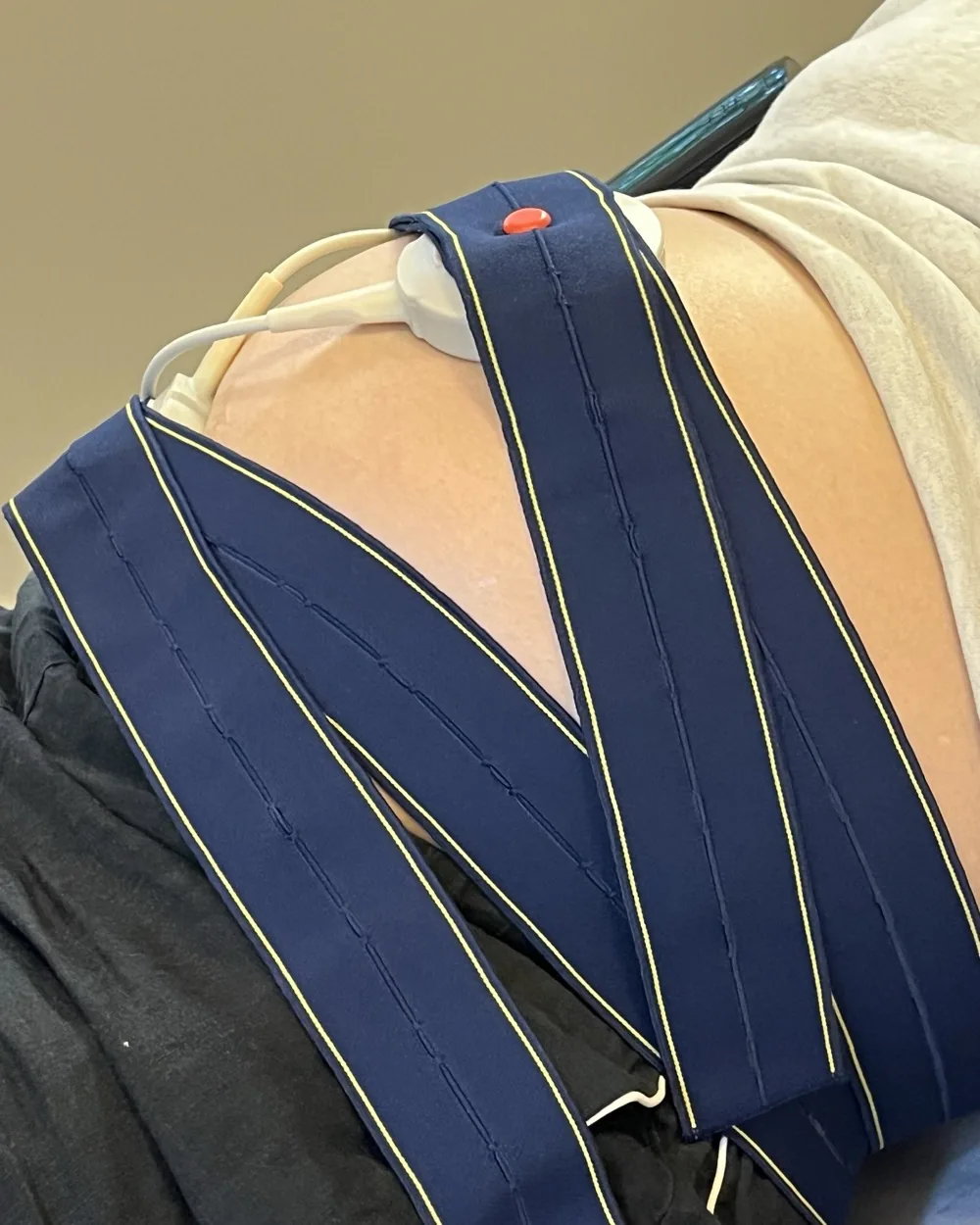
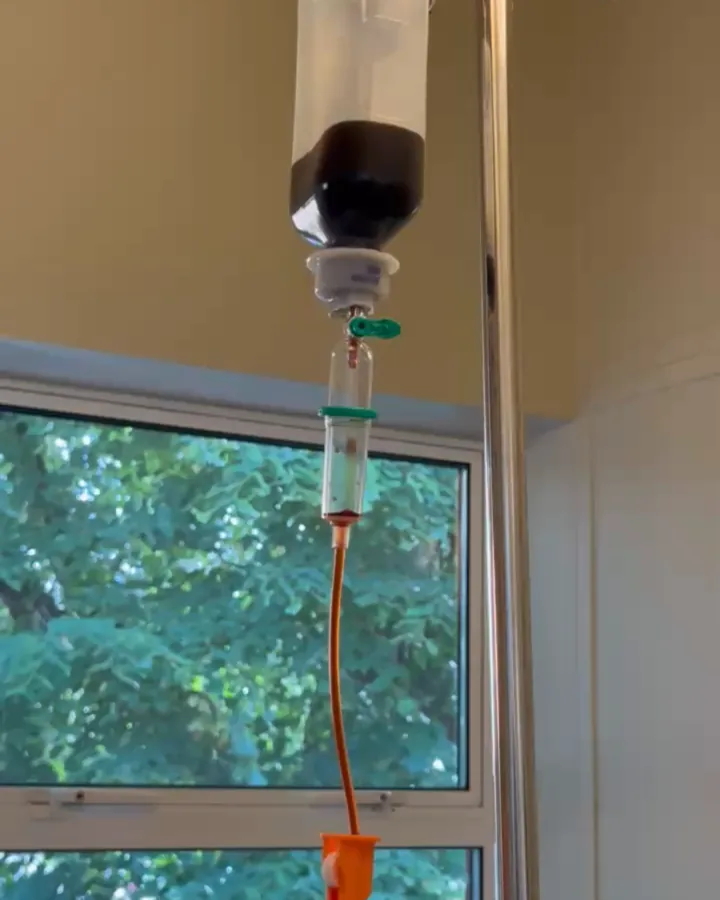
Photographed at IronOx Clinic, Cardiff, and published with the patient's written consent. CTG fetal monitoring runs on every antenatal infusion as standard; whether IV iron itself is appropriate for you is decided by Dr Ros at your assessment.
What our patients say
"I wouldn't go anywhere else. I appreciate the honesty and the infectious personality. Always feel completely at ease."
Iron infusion in pregnancy — common questions
That depends entirely on where. At IronOx your infusion is given in an independent hospital registered with Healthcare Inspectorate Wales (HIW/02039RM), by a doctor with acute and emergency medicine expertise, with an NMC-registered midwife present and CTG monitoring on your baby for the whole session. The iron is ferric carboxymaltose, the same IV iron used across NHS hospitals, given slowly rather than as a rapid injection, with observations throughout and for thirty minutes afterwards. Serious reactions are rare — around 1 in 10,000 infusions — and the room is staffed and equipped for one.
IV iron is used in UK maternity care from the second trimester when oral iron isn't enough or isn't tolerated. It has a well-described safety profile rather than a risk-free one: side effects are usually mild, and reactions are uncommon but possible, which is why you are monitored throughout — you and your baby both. Dr Ros assesses whether it is appropriate for you before anything is given, and will say so if it isn't.
Yes. Every antenatal infusion at IronOx is run with an NMC-registered midwife in the room for the whole session — not on call, and not down the corridor. Your own midwife and GP also receive a full clinical report within 24 hours, so your maternity care stays joined up.
Yes. CTG fetal monitoring runs on every antenatal infusion at IronOx as standard — your baby's heart rate is traced continuously from before the iron starts running until after it finishes. It isn't something you have to ask for or qualify for. The photographs on this page are that monitoring, on a real patient. You also have maternal observations throughout the session and for thirty minutes afterwards.
From the second trimester — after 13 weeks. IV iron is not routinely given in the first trimester because safety data for that period is limited, so we do not treat in it. Your gestation, your bloods and your maternity plan are all confirmed at your clinical assessment before any treatment is arranged.
Studies suggest oral iron causes gastrointestinal side effects in up to 40% of people who take it. That is a clinical reason to change treatment, and it matters more if you are already managing piles or a prolapse. IV iron goes straight into the bloodstream and bypasses the gut entirely, which is why it avoids that problem.
Retesting intervals are a normal part of maternity care, and waiting is a reasonable choice. What private testing changes is timing: you can know your ferritin and haemoglobin this week rather than at your next antenatal appointment, and act on it sooner if it is low. Whatever we find goes back to your midwife and GP either way.
No referral is needed — you can book a consultation directly. We do ask your permission to write to your GP and maternity team afterwards, and we would always encourage you to tell your midwife you are coming. Joined-up records are safer for you and your baby than treatment nobody else knows about.
Yes, and we make that easy. Within 24 hours of your infusion we send a full clinical report to your GP and maternity team: your pre-treatment bloods, the dose given, how you were during the session, and any follow-up we've recommended. Your pregnancy care stays with them — we fill in the iron part of the picture.
Many patients notice a change in energy, breathlessness and brain fog within one to two weeks as iron stores refill, and some report a difference within days. It is not instant and it is not guaranteed — how much you improve depends on how low your levels were, and on whether iron was the whole story.
Correcting iron deficiency can reduce the risks associated with anaemia in pregnancy, including fatigue, reduced exercise tolerance, and the possibility of needing a blood transfusion around delivery. What that means for you specifically depends on your levels and your maternity history, and is something to discuss at your assessment.
The consultation is free. Treatment is £699 for IronOx 500 or £899 for IronOx 1000, both all-inclusive — your clinical assessment, the infusion, monitoring throughout the session, and the report to your GP and maternity team. There are no hidden fees and no charge if treatment isn't appropriate for you.
Iron infusion during pregnancy should only be given following a clinical assessment by a qualified medical professional. The information on this page is not a substitute for individual medical advice, and it is not a replacement for your antenatal care. If you are pregnant and concerned about iron deficiency, speak to your midwife or GP, or book a consultation with us.
The iron takes weeks. You have fewer than you think.
Demand peaks in the third trimester — exactly when there's least time left to do anything about it. Tablets need six to eight weeks to move your levels, if you can tolerate them at all. A retest at 32 weeks is another month of feeling like this before anything changes.
Here, your free telephone consultation and your infusion can both happen this week.
No referral, no deposit, no card. You only pay if you choose to go ahead — and your own midwife gets the report either way.
Book Your Free Telephone Consultation